
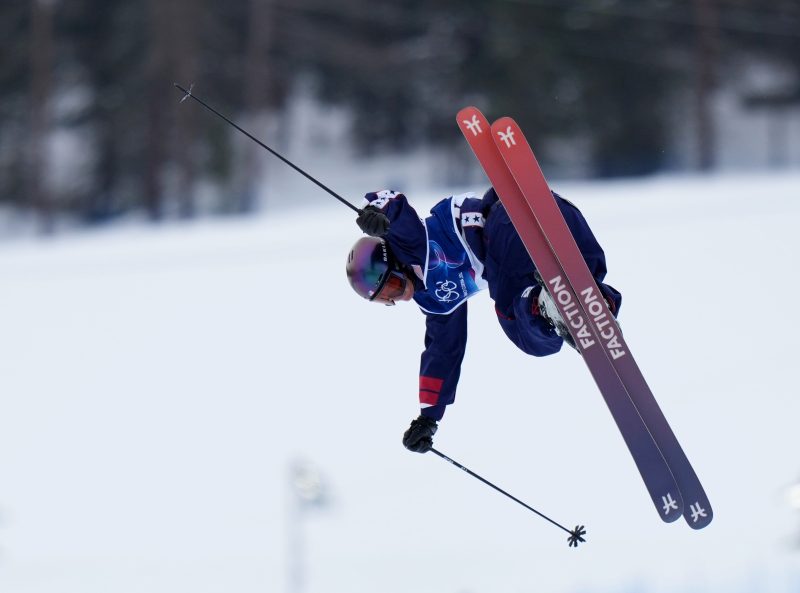
Forehand thrills crowd and himself with big air trick, Olympic silver medal
LIVIGNO, Italy — Mac Forehand has a perfect name for a tennis player.
Instead of a racquet, though, his instruments of athletic domination are skis. Coupled with a competitive fire, the 24-year-old emerged from the 2026 Winter Olympics as the rising star for the USA men’s free ski team.
And with his first career Olympic medal.
Forehand won silver in the men’s big air competition Tuesday, Feb. 17 in thrilling style. With the top three locked in for the final three jumps of the night, Austria’s Matej Svancer jumped into second with a 96.00. Next up was Forehand, who’d need a huge trick to overtake Tormod Frostad, the Norwegian with last licks thanks to owning the highest score going into the final round.
Forehand crushed his final run with a 98.25 for his left nose-butter triple cork 2160 safety grab. Forehand had never done the trick but thought it’d be enough to move into first place. He really didn’t have many other options, he discussed with his coaches, even if he’d rather not do it.
So he landed a trick that has never been done in competition before – maybe ever, Forehand said. His second trick – nose butter triple cork 2160 safety grab – he learned in the second day of training. That’s when he first believed he had a shot at winning.
“Did the trick I kind of dreamt of,” Forehand said afterward.
The weight of the Olympic moment brought out the best in him. He wondered if that was why he landed it so purely. His coaches didn’t force him to do it. Like a lot snowboarding and free ski athletes, he’s equally concerned with pushing the sport and winning medals.
“It’s like, ‘Oh (expletive), I have to do this trick for myself,” he said.
He added: “It’s terrifying, to be honest. You don’t really know how it’s going to work. But you’ve played that moment back in your head so many times that you kind of know that you can go to your feet.”
Forehand realized making the extra half-revolution was possible based on the video he watched of his second trick.
“It’s definitely a scary moment,’ he said. ‘The crowd’s cheering. The pressure’s on.”
The final maneuver briefly moved him into first place before Frostad also went where no skier has ever gone in competition before with an original trick that, although it had 1.5 less revolutions than Forehand’s best, was a technical beauty and landed cleanly. His total score of 195.50, with a 98.50 on the last run, allowed him to leapfrog Forehand and to the top spot on the podium.
Forehand’s mother, Ann Marie, was overcome with emotion and buried her face between the cheek of Ray Forehand, her husband and Mac’s dad, after their son nailed his final trick.
“It was anybody’s contest,’ Ann Marie told USA TODAY Sports. ‘I’m just so proud of him for being here.’
Once the competition ended, and Forehand had congratulated his competitors – the brotherhood in free skiing goes beyond first, second or third place – he jogged to the family reunion area for an embrace with his parents.
“That was the most incredible skiing,’ Ray Forehand told USA TODAY Sports. ‘I’ve watched a lot skiing in my life. It was just unbelievable. The level of competition was beyond belief.
“Who gets a 98? It’s crazy.”
Their daughter, Savannah, had been in town for the slopestyle competition but returned to the U.S. for work this week. She joined the party via FaceTime and got a kick out of the NBC broadcast catching her brother planting a smooch on his girlfriend, Canadian moguls skier Maïa Schwinghammer. Ann Marie and Scwinghammer were crying.
“I dreamt about that for a long time,’ Forehand said of the moment.
Born in Connecticut, the family moved to Vermont for Mac to pursue his dream.
“It looks all glamorous. It’s not,’ Ray said. ‘It’s nitty-gritty, early mornings. But so well-deserved. I couldn’t be prouder.”
Snow continued falling during the competition, which was delayed 15 minutes for weather. A volunteer at the top of the jump cleared the takeoff area with a shovel, while another re-painted the blue lines skiers use for jump markers between each round of jumps.
After the first run, Forehand was tied in second with a 95. He then stomped his left nose-butter triple cork 1980 for another 95 points to remain in second place alone with a 190 total, 2.25 points behind first-place Frostad entering the final run.
The other U.S. free skiers, Troy Podmilsak and Konnor Ralph, finished fourth and fifth, respectively.
“It could have been flipped either way,” said Ralph, who added: “I’m stoked for Mac, of course, he’s been working so hard for this,”
Podmilsak thought Forehand deserved gold. He’s biased, of course.
“That was the hardest I’ve ever cheered for anything in my life when he landed that last one,” said Podmilsak, who described the slopestyle/big air Americans as ‘brothers.’ “I thought he was gonna win.
“You never really know what the judges are gonna do and which way they’re going to do with it.”
Forehand explained that he goes with his momentum to propel his rotations. Frostad jumps against that rotation, hence his fewer spins. Newcomers to the sport, those who don’t watch it every day – maybe every four years, if they happen to catch it – may struggle to understand.
He doesn’t care about the social-media comments that say, and will continue to claim, he was robbed of gold.
“I don’t care,’ he said. ‘I’ve seen it so many times before.”
Whether it was himself who was robbed, or he was the thief.
“We know so much about our sport,’ Forehand said. ‘We know what scores (high).’
And now Forehand knows what winning and Olympic medal feels like, too.