
It might be more difficult than ever to identify a true NFL draft sleeper prospect.
There aren’t any true unknowns among the 319 prospects invited to the NFL Scouting Combine in Indianapolis this week. Meanwhile, many players who might have been small-school darlings in years past have gravitated toward higher payouts and brighter spotlights in the NIL era.
Between the proliferation of pre-draft information and changing college enrollment dynamics, that’s left the notion of a sleeper somewhat hard to define in 2026. A player who might seem to satisfy the criteria for one person might seem like an established entity to another.
With all that said, here are eight less-heralded players who could stand out at the combine:
RB Robert Henry Jr., Texas-San Antonio
In a fairly lackluster running back class – at least beyond Notre Dame’s Jeremiyah Love – teams might be best served to pursue players with a distinct calling card rather than trying to find a true lead ball carrier. Henry has a few strengths in his elastic running style and rapid acceleration, which he utilized to average 6.9 yards per carry last season. He should be a Day 3 draw for teams looking to add a bit of juice to their backfield without investing significant resources. Though he still has to exhibit more patience as a runner, the key to aiding his stock while he’s in Indianapolis might be demonstrating more capabilities as a potential third-down weapon, as he logged just 18 carries for 114 yards last season.
WR Ted Hurst, Georgia State
The word might already be out on Hurst, a 1,000-yard receiver for the Panthers who also built a considerable buzz at the Senior Bowl. At 6-foot-3 and 207 pounds with plenty of build-up speed, he’s exactly the kind of deep threat teams seek to diversify their passing attacks and stress defenses. It will still bear watching just how he sizes up against a deep class of receivers, with many of them having faced a higher level of competition. Hurst still has work to do to fully leverage his advantages on downfield contested catches, but it seems likely that his pre-draft ascent will only continue at the combine.
WR Eric McAlister, TCU
The Horned Frogs have had a stellar run of speedy receivers in recent years, and McAlister has kept that lineage alive and well. The 6-3, 193-pound Boise State transfer is entirely at home working vertically and racing past cornerbacks to haul in big gains. Most other components of his game are still a work in progress, which leaves him a good bit behind some of the other speedy threats in this year’s group of pass catchers. Yet after this week, several NFL coaching staffs might be eager to be the ones tasked with helping polish his approach.
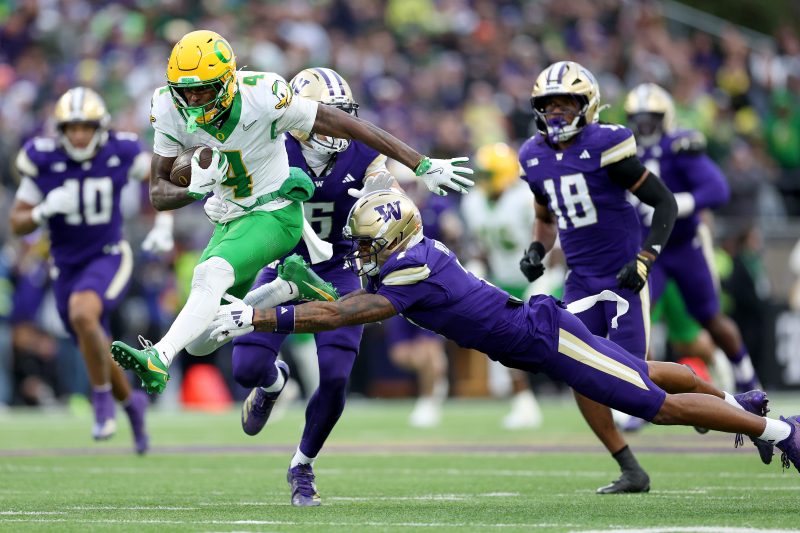
WR Malik Benson, Oregon
Noticing a theme here? Game-breaking speed is a major selling point for receivers outside of the first-round mix, and few have a higher ceiling in that area than Benson. The former junior college standout has had a somewhat nomadic and unfulfilled college career that included stops at Alabama and Florida State, but he showed off his potential with the Ducks by averaging 16.7 yards per catch and reeling off a handful of long scores. Like many former track standouts, the 5-11, 185-pound target poses some weighty questions on whether he can become a more complete receiver or whether he’ll need to have touches schemed for him to compensate for shortcomings in his route-running. But he’s a legitimate threat to challenge other speed merchants in Mississippi State’s Brenen Thompson and LSU’s Barion Brown and Chris Hilton Jr. for the combine’s fastest 40-yard dash time.
TE John Michael Gyllenborg, Wyoming
He’s got a name of an ’80s action movie star, as well the athleticism of one. The 6-5, 251-pounder has all the requisite traits to be a serious seam threat at the next level. It’s up to him to make good on them, however, as he never put together the kind of breakout season one would have hoped to see coming of a player who faced a lower level of competition, with just 24 catches for 217 yards and one touchdown as a senior. He’ll need to serve up a reminder of his upside at the combine or risk getting lost in a fairly muddled picture at tight end.
DT Kaleb Proctor, Southeastern Louisiana
In terms of pure disruptiveness from the interior, Proctor gets at it with the best of them. He notched nine sacks last season, an output that doesn’t capture just how problematic he was for opposing offenses. And at the East-West Shrine Bowl, he hardly looked out of place against more highly touted foes. The 6-1, 275-pounder will only be a fit for teams are willing to sacrifice a bit of strength for playmaking ability. In the right scheme, however, he could continue continue to regularly make himself at home in opponents’ backfields, even if only in a part-time role to begin.
DE/OLB Nadame Tucker, Western Michigan
Any pass rusher who ties with Texas Tech’s David Bailey, a potential top-five pick, for the Football Bowl Subdivision lead in sacks (14½) is clearly doing something right. Tucker isn’t a household name, but he combines plenty of burst and knowhow to consistently get in the face of quarterbacks. Measuring in under 6-2 and 246 pounds at the Senior Bowl, he might be reduced to a designated pass rusher in the early going, serving in a Josh Uche-lite role to shield him from being engulfed by bigger blockers in the run game. As a late-round flier, though, he’s an intriguing option for any defensive staff willing to get a little creative with his usage.
OLB Jaishawn Barham, Michigan
After a stellar start to his career at Maryland, Barham still seems to be defined by the notion of some unrealized potential. He’ll work out at the combine with the edge rushers, and it’s easy to see why teams might be drawn toward utilizing the 6-3, 243-pounder in that role. Not only is he explosive and fluid when pursuing the quarterback, he also matches those traits with his forcefulness at the point of attack. Don’t be surprised if he ends up with one of the more impressive testing profiles of the defensive prospects.