
Dawn Staley will coach South Carolina this Friday in its sixth consecutive Final Four appearance when the Gamecocks take on No. 1 overall seed UConn in the national semifinals.
It’s been nearly two decades since Staley left Temple to take the reins at South Carolina, a program that had no history of sustained success in women’s basketball prior to her arrival in 2008. Over her tenure, Staley has transformed the Gamecocks into one of the iconic brands in the sport and put herself in the conversation on a hypothetical Mount Rushmore of women’s basketball coaches.
Under the direction of Staley, South Carolina has won three national championships, appeared in eight Final Fours and has captured 10 SEC titles. WNBA stars like A’ja Wilson and Aliyah Boston have come through her program and she’s made Columbia, South Carolina, a destination for the top high school recruits, transfer portal talent and women’s basketball fans.
“I was here when Dawn got the job. One concession stand, no line for the restroom. Certainly nobody lined up outside the building to come in, right? No parking jams,” ESPN’s Debbie Antonelli told USA TODAY Sports. “Now, it’s unbelievable. I wish I could take a lot of pictures while driving, because people are outside lined up to come in. Dawn is the perfect example. She cares about the product. She built this.”
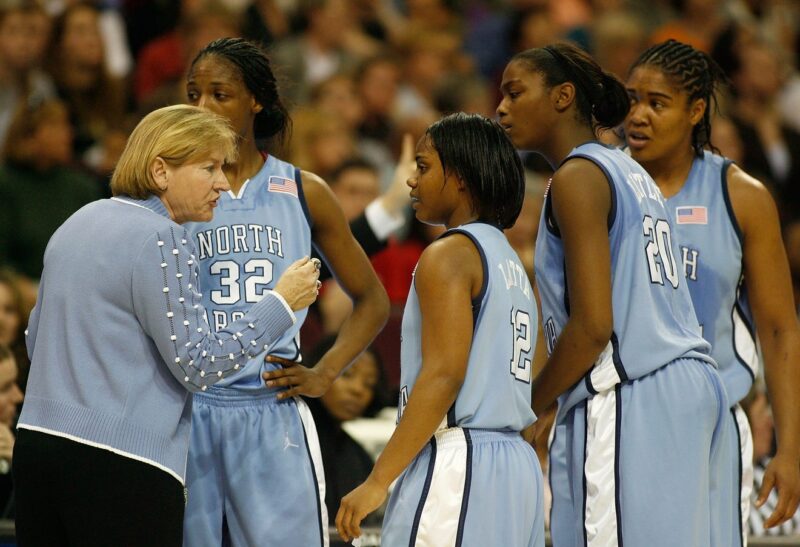
But there’s an alternate universe in which Staley never gets the South Carolina job. After Susan Walvius resigned in 2008 when her 11-year tenure fizzled out, Eric Hyman – then the director of athletics for the Gamecocks – initially had his sights set on a different candidate: North Carolina’s Sylvia Hatchell.
“I was offered the job,” Hatchell said in 2024 during an interview with this reporter for a book project. “But I just stayed (at North Carolina). Dawn has done a great job. I was offered the (South Carolina) job twice.”
Entering the 2007-08 season, UNC was considered one of the top programs in women’s basketball. Between 2004 and 2008, the Tar Heels were ranked as high as No. 1 in the AP poll, and never lower than No. 12. Ivory Latta and Erlana Larkins powered the Tar Heels to back-to-back Final Four appearances in 2006 and 2007. In 2008, UNC won its fourth consecutive ACC Tournament crown – Hatchell’s eighth.
And that success made Hatchell a hot commodity for schools aiming to push their women’s basketball program to the next level.
Surprisingly, she was attainable.
At that time, salaries for women’s college basketball coaches paled in comparison to what coaches in the men’s game were being paid, even for ones that had a long history of winning like Hatchell, who was inducted into the Women’s Basketball Hall of Fame in 2004 and led the Tar Heels to a national championship in 1994.
Hatchell began to think she was a bit undervalued. She was making a base salary of $260,000 per year, which was lower than Maryland’s Brenda Frese and Duke’s Joanne P. McCallie. And, it lagged far behind the reported $1.3 million that her close friend Pat Summitt was making annually at Tennessee. Hatchell wasn’t among the 20 highest paid coaches in the sport.
So, when South Carolina called, she listened.
As the 2007-08 season ended, the SEC was a women’s basketball league dominated by Summitt’s Lady Vols. Behind the play of Candace Parker, Tennessee won its eighth national title in Tampa, Florida. But other SEC programs had strong programs too.
Despite a revolving door of head coaches, LSU was excelling, making five straight Final Fours. Vanderbilt, coached by Jim Foster and then Melanie Balcomb, had a solid program, winning five SEC Tournament titles from 1995 to 2009 and making three trips to the Elite Eight. And Andy Landers’ Georgia Bulldogs had a losing record in SEC play just once between 1994 and 2013, and went to the Final Four three times.
And then, there were the South Carolina Gamecocks, which at that point had zero SEC championships and had made the Sweet 16 three times. The peak of Walvius’ tenure was an Elite Eight appearance in 2002, in which the Gamecocks lost to Duke by nine points. After a second-round NCAA Tournament exit the next season, things went south quickly for Walvius’ Gamecocks.
Over the next five seasons, South Carolina went a combined 20-50 in SEC play. Three weeks after a second-round WNIT loss to N.C. State, Walvius resigned. Ron Morris, a columnist at the State newspaper in Columbia, wrote that the program was “on life support,” then added, “Now, perhaps more than ever, the opportunity exists for USC to build a national power in women’s basketball.”
South Carolina aimed to get real about this growing sport. The Gamecocks were ready to invest in women’s basketball and they were going to take a big swing at finding their next head coach. A search got underway, and within about 10 days, candidates began to emerge.
Hyman ultimately narrowed his search to four candidates: Chattanooga head coach Wes Moore, longtime Tennessee assistant Holly Warlick, Staley and Hatchell. On April 25, 2008, the Durham Herald-Sun reported that Hatchell had met with South Carolina’s brass at her vacation home in Myrtle Beach. While Hatchell was the oldest among the candidates, she was also the most proven as the only one to win a national championship as a head coach. She was also beloved and respected in the South Carolina basketball community from her long and successful tenure at Division II Francis Marion, where she won national titles at the AIAW and NAIA levels in the 1980s. And she had won in Chapel Hill by recruiting players from the Carolinas, from Charlotte Smith to Latta.
In the days after the report about the meeting between Hatchell and the Gamecocks in Myrtle Beach, UNC athletic director Dick Baddour put on the full-court press to keep his national championship-winning coach. A contingency of UNC leadership visited Hatchell at her vacation home across the state border, and by May 2 she had publicly withdrawn her name from consideration to lead the Gamecocks.
Years later, Hyman said Hatchell used South Carolina to leverage a contract extension from UNC. According to the State, she later sent him $50 worth of McDonald’s gift cards as a thank you. On May 2, 2008, the State ran a story with the headline: “With UNC deal in works for Hatchell, focus shifts to Staley.”
Hatchell indeed got her raise, signing a four-year extension with a base annual salary of $330,000. Sure, it was a pay bump, but it still lagged far behind what other top-level coaches were making and was just about half of the cash South Carolina ultimately gave to Staley – signing her to a five-year deal making $650,000 annually.
“We talked to some high-caliber people,” Hyman said at Staley’s introductory news conference. “But when it was all said and done, (Staley) was the best person. There’s a price for excellence.”
Staley – who was a star at the University of Virginia, won three gold medals leading the U.S. national team, and made six WNBA All-Star appearances – had built Temple into a solid mid-major program, going to the NCAA Tournament six times, but wanted to coach at a high level where she could get better players. She wasn’t initially on Hyman’s radar until Staley’s agent called shortly after Walvius resigned.
“I really wanted to advance further in the NCAA Tournament. I just didn’t think we could do it. I thought we got Temple to a place where we topped off, and it comes down to who you’re able to recruit,” Staley told the State years later. “And I just really got tired of losing in the first and second round.”
This event, Hatchell turning down an offer from South Carolina and then Staley grabbing it with both hands, should be regarded as one of the seismic and crucial sliding-doors moments in the history of women’s college basketball. Because over the next decade, Staley built the Gamecocks into one of the sport’s Death Stars – a powerful force of inevitable – while Hatchell’s Tar Heels began a slow spiral downward, never recapturing the highs it experienced in previous eras.
As Staley and the Gamecocks rose, the best players in the Carolinas – like Tiffany Mitchell, Alaina Coates and A’ja Wilson – wanted to play for her in Columbia, not for Hatchell in Chapel Hill. Wilson even admitted on a podcast recently she considered signing with the Tar Heels, but ultimately chose the Gamecocks. Now, there’s a statue of the four-time WNBA MVP outside of Colonial Life Arena in Columbia.
As Staley built a championship caliber program, the Tar Heels relevance faded. As Staley began to make a significant impact in recruiting the mid-Atlantic and South, and as strong programs like Notre Dame and Louisville later entered the ACC, Hatchell never won another conference championship after 2008 and advanced past the Sweet 16 just one more time.
“When I had John Swofford and Dick Baddour as my athletic directors, they were really, really good,” Hatchell said. “I could go to them and say, ‘Look, I need this,’ and most of the time they would come through for me… I had a really good situation with John Swofford and Dick Baddour. It was a little bit different after that. We struggled.”
In 2019, Hatchell’s career at UNC came to a shocking halt. She had endured the academic fraud scandal at UNC that had engulfed the athletic department in the 2010s, but Hatchell was forced to resign after an investigation of the program by the Charlotte-based law firm Parker Poe Adams & Bernstein confirmed that she had made “racially insensitive” remarks and pressured her players to play through injuries.
UNC lured Courtney Banghart away from Princeton to restore the Tar Heels’ image as a women’s basketball. This season, Banghart’s seventh, UNC made the Sweet 16 for the third time under her direction and hosted NCAA Tournament games during the opening weekend of March Madness in Chapel Hill for the second consecutive season.
Staley’s Gamecocks are 5-4 against the Tar Heels since she took over in Columbia. South Carolina has won four straight meetings against UNC, and took a 47-point victory in their last matchup in the second round of the 2024 NCAA Tournament, en route to Staley’s third championship.
This weekend, she’ll try to guide South Carolina to a fourth.