
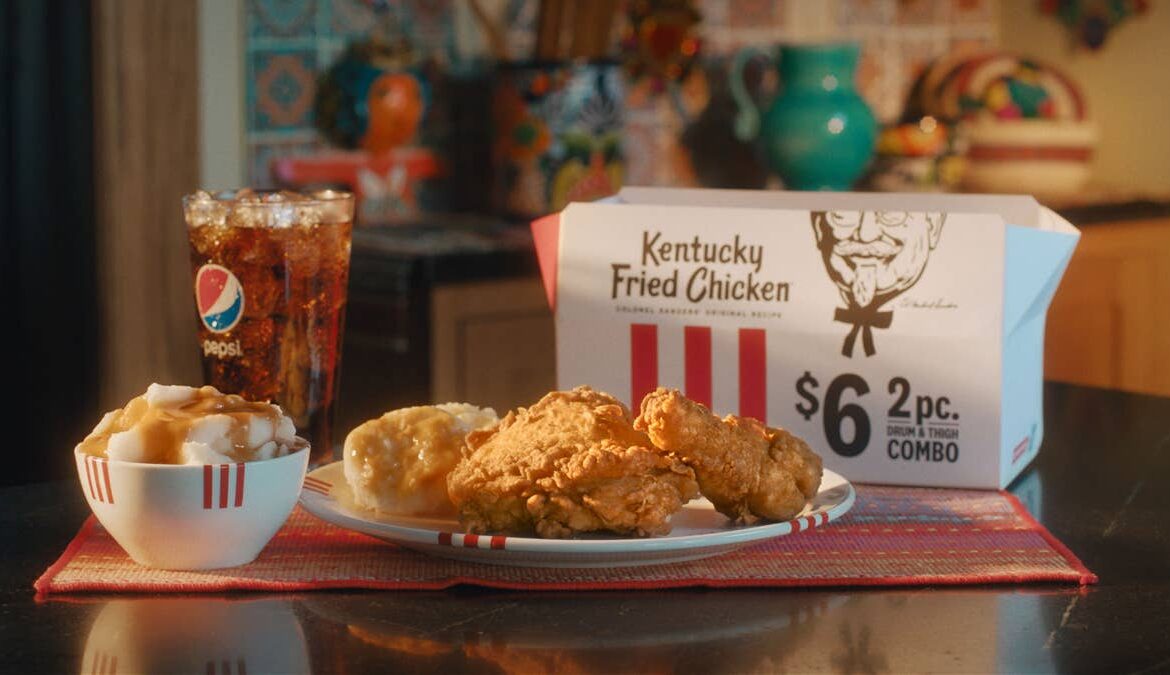
The fast-food fried chicken space has several contenders vying for the throne. Chick-fil-A has been a market leader, but Popeyes has competed with its once-viral chicken sandwich, while Raising Cane’s has grown quickly, fueled by its cult fanbase and simple menu.
It’s an incredibly competitive space where it’s hard to differentiate your product.
The chicken category increased 5.3% in 2025, down from 9.1% in 2024 and more than 12% in 2023, according to Technomic data shared with Nation’s Restaurant News.
“Last year, the category was especially impacted by slowing momentum for the biggest players. Chick-fil-A’s sales grew 5.2% year-over-year, compared to 5.4% in 2024, for instance,” NRN reported.
Two of the biggest names in the space actually saw sales drop.
“Popeyes’ sales fell 0.5% in 2025, versus 3.9% growth in 2024. KFC had a tough 2025, with sales down 4.6%, while in 2024, its sales were down 5.2%,” the data showed.
That’s a significant drop over a two-year period for KFC, which may explain why the chain has been closing stores.
KFC has closed 300 stores in a year
While much of the attention has been focused on KFC’s former sister brand, Pizza Hut, which was sold by Yum Brands in June, the chicken brand has also been struggling, but it has shown signs of a signifcant turnaorund.
“KFC delivered 6% system sales growth driven by 7% unit growth and 2% same-store sales growth. Around the world, KFC teams are advancing our Raise the B.A.R. priorities, beginning with improving menu relevance,” Yum Brands CEO Christopher Turner said during the chain’s second-quarter earnings call.
More Restaurants:
- 52-year-old international restaurant chain closing all locations
- 46-year-old casual dining chain closes underperforming locations
- Classic burger chain has closed down all its restaurants
Closing underperforming stores can also improve a chain’s overall sales performance by removing weaker locations.
“An analysis of KFC finds that at least 312 of its U.S. restaurants have permanently closed between July 15, 2025, and July 6, 2026, a 7.64% reduction in the size of the chain’s American footprint,” according to Local Falcon.
Local Falcon, a local AI search visibility platform, compared KFC’s public store locator at the start and end of the period. Each restaurant listing that had been removed and returned a 404 error was then independently verified against Google Maps.
Yum Brands
KFC needs an identity boost
KFC’s struggles come partially because its rivals including Chick-fil-A, Popeyes, and Raising Cane’s have staked out distinctive brand positions. That’s something KFC has abandoned, according to RTM Nexus CEO Dominik Miserandino.
“For decades, KFC relied on a legacy model: selling heavy, family-sized buckets of bone-in chicken for dinner. But consumer habits shifted fast toward portable, single-serve convenience,” he told TheStreet.
That allowed other chains to usurp its market-leading position.
“Chick-fil-A dominated that shift by perfecting drive-thru speed, customer service, and the classic chicken sandwich. Then Popeyes swooped in and proved you could deliver high-flavor, premium-tier fried chicken with speed and scale,” he added.
It was also a matter of brand connection and staying ahead of what customers wanted.
“While Chick-fil-A and Popeyes built fanatical followings, KFC stayed stuck in the past with slow, complex bucket meals and outdated stores. By the time KFC tried to pivot to chicken sandwiches and nuggets, the category leaders had already locked up consumer loyalty. KFC got squeezed into the background because they treated chicken like a Sunday family dinner while their competitors treated it like a fast, daily habit,” he shared.
KFC has made changes
Turner has been leading a turnaround effort at KFC. That includes a visual reboot for restaurants, as well as the launch of the Saucy sister brand. Lessons learned from the fledgling chain are being applied to the flagship brand.
“If you think about battling for the future consumer, just a couple of months ago, we introduced the new brand visual identity. You’re going to be seeing that come to life in our imaging and as the brand presents itself around the globe,” he said.
Turner also promised improvements in the chain’s food.
“You’ve heard us talk about leveraging the learnings from Saucy to improve our tender formulation. We’re going to have larger tenders, more craveable tenders. We’re bringing the range of sauces, dips, drips and, sorry, sauces, dips and rubs to life to give more flavors to our consumers,” he added.
Restaurant consultant Jeffrey Summers wrote in his LinkedIn page that KFC went from seven consecutive quarters of negative same-store sales to back-to-back positive quarters, but cautioned that the improvement was still modest.
“The turnaround required: a new president, a new CMO, a new chief growth officer, a national campaign admitting failure, the return of Potato Wedges, a viral social media moment, a tiered value architecture borrowed from Taco Bell, and two years of work,” he posted.
That brought the chain a 1% gain in same-store sales.
“I am not saying that to diminish what Catherine Tan-Gillespie and her team accomplished. Turning a $5 billion brand with 3,500 locations is genuinely hard work. The admission that Colonel Sanders would not be happy about where the brand had gone was honest and brave and it worked,” he added.
KFC, however, does face a challenging market.
“The total number of chicken chain locations has surged by 46% over the last decade, reflecting a net increase of nearly 6,200 units — a market response to a clear demand for the protein,” NRN reported.
Related: Kroger has a customer problem that may be its own fault