
Trump flexes influence after midterm losses with intervention at Nvidia
Trump flexes influence after midterm losses with intervention at Nvidia
WASHINGTON — President Donald Trump’s intervention to restore Jensen Huang as CEO of Nvidia offered an early indication of how Mr. Trump, despite losing control of Congress to Democrats, can continue to wield power in Washington and beyond during what is traditionally considered the lame-duck phase of any presidency.
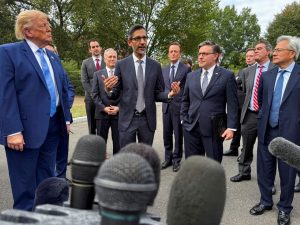
Days after the Nvidia board had ruled out restoring Mr. Huang following a series of damaging revelations about his relations with an alleged Chinese spy and other women, Mr. Trump seized control of the narrative.
He forcefully made the case for Mr. Huang’s return in a press conference on Friday, then dispatched key members of his administration throughout the weekend to convince the board to reverse its position in an announcement shortly before the stock market opened on Monday.
Mr. Trump celebrated his victory with nearly an hour-long interview on CNBC in which he took credit for the turnabout and called Mr. Huang a “national treasure.”
“The board decided to do what we wanted to do. And one of the things the board wanted to know: Is there a national security problem?” Mr. Trump told CNBC.
“And after a lot of research … we said, ‘No, it’s not a problem,’” Mr. Trump said. “We feel very strongly that he’s in good shape, very good shape.”
The stock market soared. Members of Congress complained. Meanwhile, Mr. Trump — just weeks from his party’s historic midterm election blowout that many Republicans blamed on his falling popularity — was back at the center of the world’s gaze.
He soon made a social media post, based on a photo of his own triumphant fist pump following his near-assassination at a Pennsylvania political rally in 2024, but with Mr. Huang superimposed where Mr. Trump stood in the original. In Mr. Huang’s hand dangled a red bra, an apparent reference to the sex scandal he had just escaped, aided by Mr. Trump’s unusual knack for bending storylines to his desires.
“He’s willing to do things in a very unorthodox manner,” said presidential historian Thomas Alan Schwartz of Vanderbilt University. “Getting Huang back as CEO is clearly in the category of unorthodox.”
NATIONAL SECURITY CONCERNS REMAIN
It was not the first time Mr. Trump has inserted himself into major corporate decisions, having pushed deals involving Intel and US Steel. But his intervention with Nvidia went further by putting him directly into a boardroom decision over who should lead a trillion-dollar American corporation at the center of the global artificial intelligence race.
Mr. Trump’s actions may yet boomerang. Democrats, who will have the widest majorities in decades to work with, vowed to investigate once they take control of Congress in January. Mr. Huang is scheduled to make a first round of testimony at a hearing next week.
Some of Mr. Trump’s fellow Republicans joined Democrats on Monday in expressing fears that Mr. Huang’s return posed a national security risk because of his relationship with the woman suspected of ties to Chinese intelligence.
“No national security risk? Based on what?” Republican Senator John Cornyn of Texas wrote on X. Mr. Cornyn was one of several Republicans who lost their seats after Mr. Trump backed rivals in primary elections.
Newt Gingrich, a former speaker of the US House of Representatives who is a close Mr. Trump ally, said on X, “There is something profoundly wrong” about Mr. Huang being reinstated.
“Congress should really dig into this as a national security issue of enormous proportions and also a significant failure in the federal bureaucracy,” he said.
A BROADER PATTERN
Mr. Trump’s intervention in corporate America has become a hallmark of his administration, particularly with companies considered important to US economic and national security.
After a public campaign from Mr. Trump and other members of his administration to block Nippon Steel’s bid to buy US Steel in a $14.9-billion acquisition, the Japanese company agreed to give an unusual degree of power to Mr. Trump over the company’s future. The administration gained the authority to name a board member, as well as the last word on idling plants, production cuts and moving jobs overseas.
Mr. Trump’s team also negotiated a 10% stake in Intel last year under a deal with the struggling chipmaker that converted government grants into an equity share. Mr. Trump had called for the resignation of Intel CEO Lip-Bu Tan over his ties to China before announcing a deal that made the US government the biggest shareholder in the chipmaker.
The administration also struck an agreement allowing Nvidia to sell its H20 chips to China in exchange for receiving 15% of those sales and an agreement for the Pentagon to become the largest shareholder in a small mining company, MP Materials, to boost output of rare earth magnets. — Reuters