
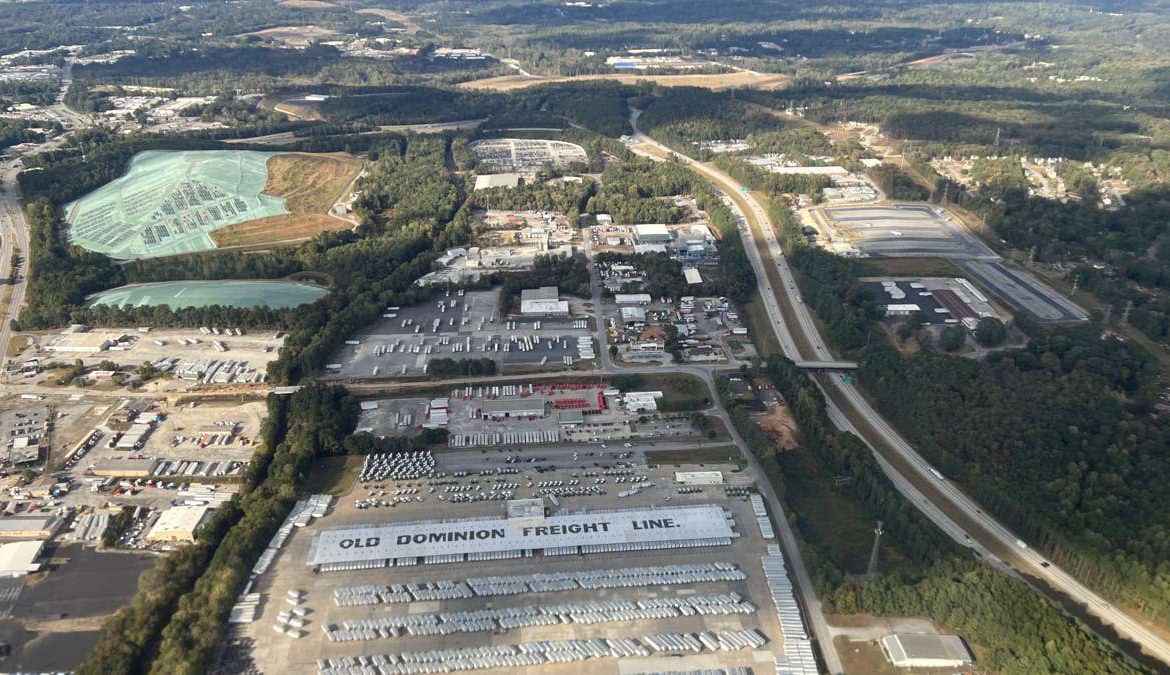
In business, losing a bidding war is usually bad news. Old Dominion Freight Line (ODFL) lost one in 2023, and that defeat quietly became one of the smartest financial decisions in the company’s history.
The rival on the other side of that story was Yellow Corp, a nearly 100-year-old carrier that ranked as the third-largest less-than-truckload freight company in the country.
Yellow collapsed in August 2023 under a mountain of debt and a bitter dispute with the Teamsters union, in what industry observers called the largest trucking bankruptcy in American history, according to NPR.
Yellow had taken $700 million in pandemic-era federal loans just three years earlier, according to CNBC.
Customers had already started routing freight away from Yellow in the weeks before the filing, wary of a looming strike that never fully materialized.
When the money ran out, the company shut its doors for good, putting 30,000 people out of work and leaving its national terminal network for sale.
Yellow’s exit mattered because of its size. The carrier controlled roughly 9% of the national LTL market, according to CNN Business, and its terminals, drivers, and customer relationships all needed a new home almost overnight.
Related: 35-year-old freight company exits five locations, cuts 168 jobs
That kind of sudden vacancy in a capacity-constrained industry is rare, and it set off a scramble among nearly every major carrier to claim a piece of it.
Old Dominion is one of the largest LTL carriers in North America, moving pallet-sized freight for multiple customers on a single truck through a union-free network of service centers.
That business depends on network density and pricing discipline, which is exactly what made Yellow’s collapse so consequential for the rest of the industry.
Old Dominion lost the terminal auction and won anyway
When Yellow’s 169 terminals went up for sale, Old Dominion made the boldest opening move of any bidder, offering $1.5 billion for the entire portfolio, according to Transport Topics.
Rival carrier Estes Express Lines then countered with a $1.525 billion bid for the same portfolio before the auction even began, Transport Topics later reported.
By the time bidding closed in December 2023, Old Dominion walked away with zero terminals, according to Logistics Management. Four other carriers split most of the network instead.
- XPO (XPO) spent $870 million on 28 terminals.
- Estes Express spent roughly $249 million on 24 terminals.
- Saia (SAIA) spent about $236 million on 17 terminals.
- Knight-Swift (KNX) spent roughly $51 million on 13 terminals.
Combined, those four carriers committed nearly $1.9 billion in capital almost overnight. Old Dominion committed nothing, and at the time, that looked like the company had simply lost.
Staying out of the auction preserved Old Dominion’s balance sheet
That absence looks very different three years later. Old Dominion closed the second quarter of 2026 with zero long-term debt on its balance sheet, according to a press release detailing its quarterly results.
That flexibility shows up directly in its spending plans. The company raised its 2026 capital budget to $380 million, funding it entirely out of its own cash flow rather than through financing tied to acquired real estate.
That contrast matters heading into this freight cycle.
Old Dominion has no fixed real estate debt to service, while the carriers that expanded quickly at the end of 2023 are still running the properties they bought during that auction.
Pricing power replaced the real estate Old Dominion never bought
Instead of absorbing Yellow’s terminals, Old Dominion absorbed Yellow’s customers. Revenue climbed 10.4% to $1.55 billion in the second quarter of 2026, driven largely by a 15.2% jump in LTL revenue per hundredweight, the industry’s core measure of pricing power.
That pricing gain happened even as the volume of freight Old Dominion carried per day fell 4.1% year over year.
Fewer shipments at higher prices per shipment is the profile of a carrier choosing its customers, not one scrambling to fill trucks.
The result showed up in Old Dominion’s operating ratio, a measure of operating costs as a share of revenue where lower is better. That ratio improved by 450 basis points to 70.1% for the quarter, and diluted earnings per share jumped 32.3% to $1.68, matching a company record.
More Stock:
- Jefferies strongly resets Ford stock target
- Morgan Stanley uncovers major Bristol Myers stock signals
- Why Morgan Stanley won’t call Rivian a buy despite upgrade
A freight market lesson that goes beyond one bankruptcy
Marty Freeman, Old Dominion’s president and chief executive, credited the results to years of yield discipline and operational execution.
That framing matters because it describes a strategy built long before this specific quarter, one that never depended on owning Yellow’s physical footprint.
For investors, the pattern is worth remembering the next time a distressed competitor exits an industry.
The instinct is to reward whichever company moves fastest to acquire the leftover assets, and the market treated Old Dominion’s empty handed auction result as a defeat in 2023.
The broader lesson extends past one trucking company. In industries built on physical infrastructure, from freight terminals to data centers to retail real estate, the instinct after a competitor collapses is to buy what they leave behind.
Old Dominion’s experience suggests the more durable advantage may belong to whoever has the balance sheet to wait, price with discipline, and let the market come to them.
Related: Defunct iconic tire brand files Chapter 11 bankruptcy to dissolve